


A Simple Dog Trick = A world of Enrichment, and a Possible Certification.


Picture this, you are in your living room with a few treats, your dog, and a harmless-looking laundry basket. A few minutes later, your dog is putting two paws in the basket, then stepping in, then proudly looking at you as if they just solved a major engineering problem.
That small moment is the heart of trick dog title certification: learning together, building skills, and giving your dog a fun job to do.
A trick title is not necessary for a dog to benefit from training. Still, a structured goal can make enrichment more consistent, help families notice progress, and give dogs more chances to practice choice, movement, problem-solving, and communication. When taught with ethical, force-free, evidence-based methods, trick training can be a wonderful addition to a dog’s life.
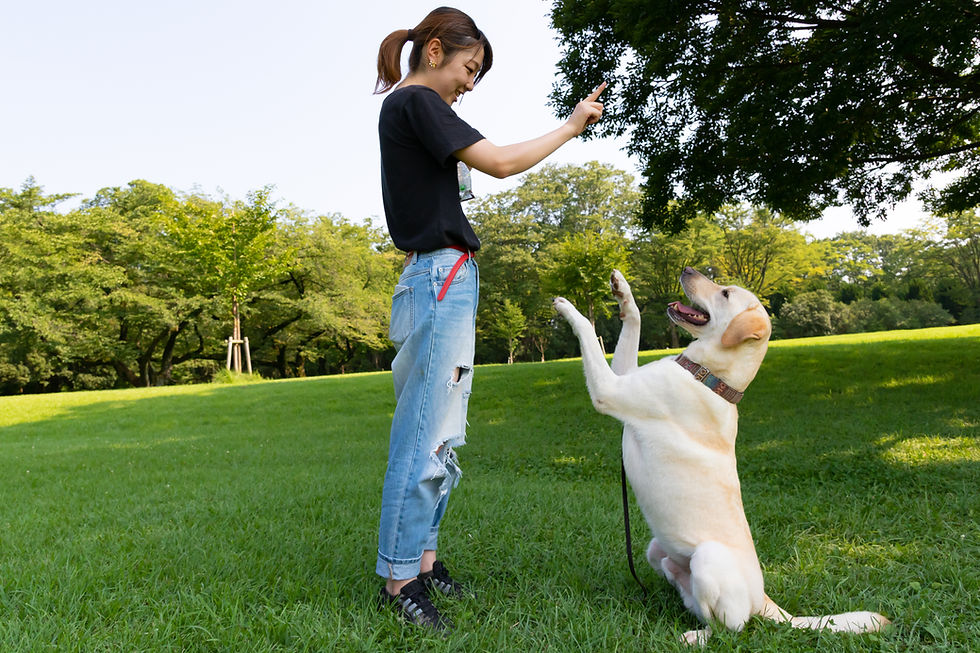
What Is Trick Dog Title Certification?
The American Kennel Club, or AKC, offers a sequence of Trick Dog titles: Novice Trick Dog, Intermediate Trick Dog, Advanced Trick Dog, Trick Dog Performer, and Trick Dog Elite Performer.
For the Novice title, a dog generally performs 10 skills from the AKC Novice checklist. A dog with an AKC Canine Good Citizen certificate or title already on record may complete five Novice tricks instead. Dogs can begin learning at any age, though AKC will not award a Trick Dog title until a dog is at least four months old.
Mixed-breed dogs can participate, too. To submit an AKC title application, a dog needs an AKC registration number, a Purebred Alternative Listing number, or enrollment in AKC Canine Partners.
Trick Dog Training is a Great Type of Enrichment
Enrichment is not just about keeping a dog busy. Good enrichment supports welfare by increasing opportunities for positive, species-appropriate behavior, activity, and engagement.
Trick training can be a valuable form of enrichment because it gives a dog repeated opportunities to learn that their behavior has meaningful outcomes. A dog offers a paw, spins, walks around an object, targets a hand, or retrieves a toy. You mark the behavior, reinforce it, and the dog gets clear feedback. That is a conversation, not a test.
Well-designed training can support animal welfare by providing learning opportunities, agency, and positive interactions with people. Enrichment activities may also support relaxation and reduce stress-related behavior, though individual responses will vary depending on the dog and the activity.

Best Parts of Trick Dog Title Certification
A title is the souvenir. The real value is the learning process.
Mental exercise: Learning new behaviors involves attention, memory, discrimination, and problem-solving. A short, successful session can provide meaningful engagement without requiring a marathon walk.
Relationship building: Reinforcement-based trick training helps people become better observers. You start noticing when your dog is tired, excited, confused, ready to try again, or silently asking, “Was that the one?”
Confidence building: Easy, achievable behaviors can help a hesitant dog develop a history of success. Start with skills that fit the dog you have, not the dog you wish you had.
Body awareness: Tricks such as stepping onto a platform, backing up, weaving through legs, or placing paws on a low object can help dogs practice coordinated movement. Choose skills appropriate for your dog’s age, body condition, and veterinary needs.
Practical life skills: Many tricks overlap with useful cooperative-care and daily-life behaviors, including chin rests, hand targets, mat work, retrieving, walking around objects, and calmly interacting with props.
A clear family goal: Certification gives households a structure. Instead of vaguely deciding to “train more,” families can select a few skills, practice in short sessions, and celebrate completed steps.
The Best Tricks Are Dog-Centered
The value of trick training does not come from making a dog perform. It comes from creating a safe learning experience where the dog can succeed.
Choose tricks that match your dog’s comfort, physical abilities, and interests. A food-motivated dog may love shaping games with small treats. A toy-loving dog may enjoy a retrieve or putting a toy into a box. A shy dog may prefer quiet target games and low, predictable props before working around more novel objects.
Avoid tricks that require forced positions, repetitive jumping, extreme flexibility, or discomfort. “Sit pretty,” repeated high jumps, prolonged hind-leg standing, crawling, and tight spins may not be suitable for every dog, especially puppies, seniors, long-backed dogs, dogs with orthopedic concerns, or dogs recovering from injury.
If your dog suddenly resists a familiar movement, moves differently, seems stiff, or becomes unusually reluctant to train, pause and speak with your veterinarian. Pain and medical conditions can change behavior and movement, and no title is worth pushing through a dog’s discomfort.
Want to Teach Your Dog a New Trick?
An AKC Trick Dog Evaluator is approved to evaluate dogs for AKC Trick Dog titles. They can help pet parents understand title requirements, select appropriate tricks, and prepare for an evaluation at a pace that supports the individual dog.
Trick training should always be adapted to your dog’s age, physical ability, comfort, and interest. If your dog seems painful, reluctant to move, suddenly avoids familiar skills, or has a medical condition that affects movement, check in with your veterinarian before practicing physically demanding tricks.
If you are curious about using trick training as enrichment, Kristie Wiest, ABCDT and AKC Trick Dog Evaluator, will be joining Carlos for a free community Q&A on Thursday, August 27. She will teach a new trick, answer practical questions about teaching tricks, pursuing AKC titles, and using positive, evidence-based training to support your dog’s mental, physical, and emotional well-being.
How to Make Trick Training Enriching
Keep trick sessions short, easy, and full of choices. Three to five minutes can be plenty, especially for a beginner or a dog who becomes overstimulated quickly.
Start with one simple skill, such as touch, paws up on a low platform, spin, or going around a cone.
Break each trick into small steps, then reinforce the steps your dog can already do.
Use food, toys, play, praise, sniff breaks, or access to something your dog enjoys as reinforcement.
Let your dog opt out. If they walk away, sniff, disengage, or show stress, make the next repetition easier or end the session.
Stop while your dog is still successful and interested. Leave them thinking, “Hey, I could do that again.”
Practice in different safe locations after the behavior is easy at home, but do not rush a dog who finds new places difficult.
Training should not be used to suppress fear, frustration, or distress. For a dog struggling with reactivity, separation-related concerns, handling sensitivity, or fear, trick work may be a helpful confidence-building activity, but it is not a replacement for an individualized behavior plan.
Certification Is Optional, Enrichment Is Not
Not every family wants to pursue an AKC title, and that is completely fine. You can teach tricks simply because your dog enjoys learning and you enjoy watching them proudly carry a sock to the laundry basket, even if the sock never actually reaches the basket.
For families who enjoy a goal, the AKC program provides a clear progression. Intermediate and Advanced titles build on earlier levels, while the Performer and Elite Performer titles involve routines and props. That structure can be especially motivating for kids, multi-person households, and people who want a positive project to share with their dog.
At k9HS Online, the goal is not to turn every dog into a performer. The goal is to help more people give their dogs an enriching, respectful life through practical, evidence-based training.
A Note from Carlos
Trick training is one of my favorite ways to remind families that training does not have to feel like homework. Your dog does not need to be flashy, fast, or perfectly focused to enjoy it. They just need lessons that are clear, kind, and matched to who they are.
If you pursue a title, celebrate it. If you teach your dog to touch a hand target and both of you have a good time, celebrate that too. A happy dog who feels safe learning with you is already doing something pretty impressive.
We do our best until we know better. This library is here to help you know better.
References
American Kennel Club. AKC Trick Dog.
American Kennel Club. Trick Dog 101: What You Need to Know.
McGowan, R. T. S., et al. “Training as Enrichment: A Critical Review.” Animal Welfare.
Hewson, C. J., et al. “Effects of Environmental Enrichment on Dog Behaviour: Pilot Study.” Animals, 2022.
University of Washington Office of Animal Welfare. Environmental Enrichment for Dogs and Puppies.
About the Author
Carlos F. Morales, CPDT-KA, CDBC, is a force-free dog trainer and behavior consultant based in Long Beach, California. He helps families build safer, happier relationships with their dogs through modern, ethical, evidence-based training. He lives in a little house by the beach with his partner, three dogs—GoGo, Kiba, and Choji—and a sassy cat named Habibti.


